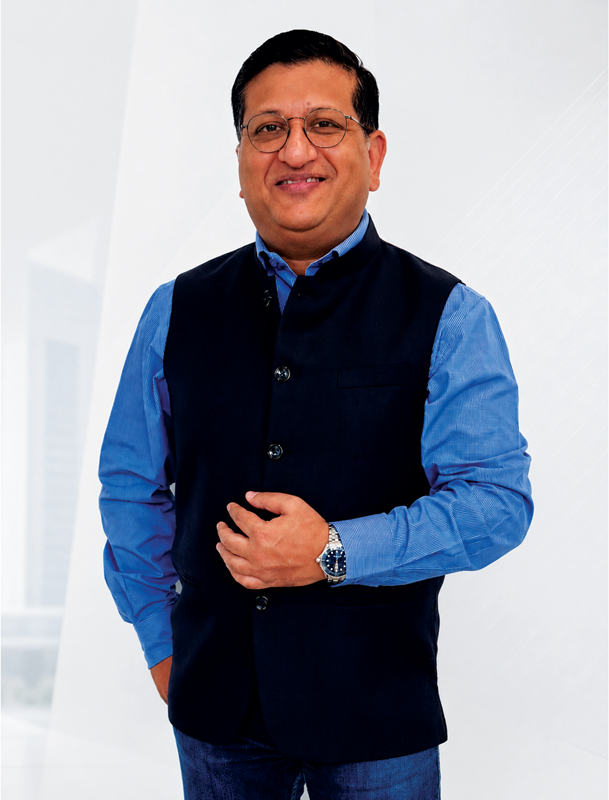
The Indian Optician (TIO): You have had a distinguished career in the eyewear industry, working with some of the world’s leading organisations, including EssilorLuxottica, before taking on your current role at JIO. Could you briefly take us through your professional journey and the experiences that have shaped your leadership style?
Akash Goyle (AG): My professional journey began nearly three decades ago as an Area Sales Manager intern with Dabur in Bihar, an experience that laid a strong foundation for my career in sales and marketing. During the late 1990s, as organised retail emerged as one of India’s fastest-growing sectors, I moved into premium apparel, working with iconic brands such as Lee, Wrangler, Arrow and Lacoste. Those years gave me invaluable exposure to retail operations, merchandising and product management.
The transition to premium accessories came naturally, leading me to EssilorLuxottica, where I spent almost two decades. It was an immensely rewarding phase that allowed me to work at the intersection of vision care, fashion and innovation.
Working across such diverse industries has shaped my leadership philosophy around two core principles:
1) The first is that a vision alone is never enough. It must be backed by an unwavering belief and a team that shares the same conviction and pursues it with determination.
2) The second is that how you achieve success is often more important than the success itself. Short-term wins may deliver immediate results, but sustainable businesses are built on integrity, trust and the right way of working.
TIO: What inspired you to take up this new responsibility at JIO, and how different is it from your previous assignment?
AG: After a fulfilling 30-year career, including 19 years in the optical industry, I felt it was the right time to challenge myself once again. Technology has always fascinated me, particularly the possibilities it offers for transforming everyday life. Joining JIO to lead their AI Devices division therefore felt like a natural progression.
The biggest difference lies in the products themselves. In my previous role, we brought together world-class eyewear design and advanced lens technology while gradually encouraging consumers to embrace lifestyle and premium products. At JIO, the velocity of innovation is driven mainly by technology and artificial intelligence.
That said, the fundamentals remain remarkably similar. Success still depends on building a strong team, understanding the aspirations of Indian consumers, developing compelling products and ensuring they are accessible at scale.
My objective at JIO is to create meaningful impact by enhancing the productivity and capabilities of millions of aspirational Indians. Seamless access to AI is central to that vision, and AI-powered devices serve as the gateway to these transformative technologies.
TIO: Having worked across different industries, including FMCG, apparel and eyewear, how do you see the Indian optical market evolving over the next five years? What major trends should retailers prepare for?
AG: The Indian optical market is entering an exciting phase and, over the next five years, I believe premiumisation will accelerate significantly. Rising disposable incomes and widespread digital connectivity have effectively eliminated the aspiration gap between metropolitan cities and Tier II and Tier III markets.
Retailers should prepare for three significant shifts, namely:
1) The ‘Wardrobe Shift’. Consumers increasingly see eyewear as an extension of their personality rather than simply a functional product. It’s no longer just about the brand; it’s about choosing eyewear that reflects individual style and suits different occasions.
2) The premiumisation of lenses. As awareness of digital eye strain and visual wellness grows, consumers are beginning to appreciate that lenses play a vital role in both comfort and eye health. High-quality lenses are finally receiving the recognition they deserve.
3) The increasing influence of data-driven technologies. Technology will enable retailers to automate routine operational task and focus more on delivering exceptional customer experiences. In the years ahead, ‘agility driven by data and consumer insights’ will distinguish the most successful retailers.
TIO: Smart eyewear is being hailed as the next major evolution in wearable technology. How do you see this category shaping the future of the optical industry in India and globally?
AG: Smart eyewear represents the natural evolution of wearable technology. Since vision, hearing and speech all converge around the face, eyewear is uniquely positioned to become the ideal platform for ambient technology. What was once considered a niche category is rapidly evolving into a mainstream opportunity.
Both globally and in India, I believe smart eyewear will fundamentally reshape the optical retail landscape. Within the next decade, I expect a majority of frames sold will be smart eyewear, while an increasing number will feature intelligent lenses.
This evolution will transform the industry’s focus from vision correction and fashion alone to delivering a connected lifestyle experience, where eyewear functions as a personal digital assistant and a real-time health companion.
For optical retailers, this creates an entirely new business opportunity. Smart eyewear introduces a technology-led revenue stream while increasing consumer engagement and strengthening long-term customer relationships.
TIO: Modern smart glasses integrate AI, voice assistance, navigation, photography, fitness tracking and communication. Which of these features do you believe will resonate most strongly with Indian consumers, and why?
AG: While the integration of multiple features into a single device is certainly impressive, I believe the capabilities that offer immediate hands-free convenience, everyday utility and a sense of aspiration will resonate most strongly with Indian consumers.
Foremost among these are AI-powered voice assistance, real-time translation and navigation. Hands-free access to information, directions and multilingual communication aligns perfectly with India’s fast-paced, mobile-first lifestyle, whether people are commuting, travelling or juggling multiple responsibilities.
Another feature with significant appeal is ambient communication and audio. The ability to take calls, listen to music or interact with the digital ecosystem while remaining fully aware of one’s surroundings offers a clear advantage over conventional earphones or headphones.
Contextual photography and videography will also attract strong interest, particularly among India’s digitally connected and social media-savvy consumers. The ability to capture moments naturally from a first-person perspective makes content creation far more intuitive and immersive.
That said, technology alone will not drive widespread adoption. For smart eyewear to truly succeed, it must first look and feel like a pair of stylish, lightweight spectacles that people are happy to wear every day. Design and comfort will always remain as important as functionality.
TIO: With increasing concerns around privacy and data security, how can manufacturers build consumer trust in smart eyewear?
AG: Trust will be the defining factor in the success of smart eyewear. When consumers wear a device capable of collecting visual and audio data, manufacturers have a responsibility to ensure that privacy and security are built into the product from the outset.
The first step is complete transparency. Features such as highly visible, tamper-proof LED indicators that clearly signal when the camera or microphone is in use can reassure both users and those around them.
Secondly, greater emphasis should be placed on data localisation and on-device processing. Consumers need confidence that sensitive visual and personal information is processed locally through ‘edge computing’ wherever possible, rather than being continuously transmitted to cloud servers.
Finally, users must have clear, simple and meaningful control over their personal data. Transparent privacy policies and easy-to-understand permission settings will play a crucial role in building confidence. Ultimately, the companies that prioritise privacy and give consumers genuine control over their data will be the ones that earn long-term trust.
TIO: Artificial Intelligence is transforming almost every aspect of technology. What role do you see AI playing in the next generation of smart eyewear?
AG: AI is the brain that turns a piece of hardware into an indispensable lifestyle co-pilot. In the next generation of smart eyewear, AI will act as an ambient, predictive layer.
Instead of requiring constant manual inputs, AI will synthesise real-time visual and auditory data to anticipate user needs – offering real-time translations during a conversation, proactively flashing critical contextual information, or optimising lens parameters based on predictive individual vision behaviour and environmental light shifts.
Beyond convenience, AI also has the potential to play a significant role in preventive healthcare. The eyes provide a unique, non-invasive window into overall health, and future AI algorithms could monitor subtle biometric changes over time to help identify indicators of stress, fatigue and broader systemic health conditions. This would enable smart eyewear to evolve from a productivity tool into a proactive health companion.
TIO: Which consumer segments do you believe will be the earliest adopters of smart eyewear in India? Do you see smart eyewear eventually becoming as commonplace as smartphones and smartwatches? Why or why not?
AG: The earliest adopters of smart eyewear in India will undoubtedly be technology enthusiasts, Gen Z consumers, digital content creators, corporate professionals managing increasingly hybrid lifestyles, and fitness enthusiasts. These are the consumers who are most receptive to innovations that enhance productivity, convenience and connectivity.
Over time, however, I firmly believe smart eyewear will become as commonplace as smartphones and smartwatches. History has consistently shown that when technology becomes smaller, more intuitive and significantly more useful, adoption accelerates rapidly. We witnessed this evolution with personal computers, followed by smartphones and, more recently, smartwatches.
As components become lighter, battery performance improves and artificial intelligence becomes more sophisticated, smart glasses will simply become everyday eyewear with intelligent capabilities built in. Consumers will no longer think of them as technology gadgets; they will see them as a more convenient and seamless alternative to constantly reaching for their smartphones.
TIO: Smart eyewear is increasingly being positioned as a premium lifestyle product rather than simply a technology gadget. Do you see it emerging as the next aspirational luxury category?
AG: Absolutely. Early attempts at smart eyewear largely failed because technology companies approached the category as a gadget for the face, overlooking the fact that eyewear is, above all, a highly personal fashion accessory.
The turning point came when the industry recognised that style must lead, with technology working quietly in the background. The success of products such as the Ray-Ban Meta collaboration clearly demonstrated that consumers are far more willing to embrace wearable technology when it is housed within stylish, desirable eyewear.
Once smart glasses successfully combine premium design with meaningful digital functionality, price becomes far less of a barrier. Consumers begin to value the overall experience rather than simply the technology itself.
Given the rapid pace of AI innovation and the growing interest from global fashion houses, I believe smart eyewear will evolve into an aspirational category across every market segment – from affordable products to premium and luxury collections.
TIO: For independent optical retailers, smart eyewear represents an entirely new business opportunity. What investments, in terms of product knowledge, customer education and after-sales service, will be essential for them to succeed in this category? What advice would you give to retailers who are considering adding smart eyewear to their product portfolio?
AG: Independent opticians have always been the backbone of the optical industry. Smart eyewear presents them with an exciting opportunity, but succeeding in this category will require a shift in mindset. Retailers will need to move beyond being traditional product sellers and position themselves as trusted technology advisers.
To succeed, investment in three key areas will be essential viz:
1. Product knowledge and staff training: Frontline teams must be equipped to explain AI features, connectivity, digital ecosystems and software functionality with the same confidence they demonstrate when recommending frames or prescription lenses.
2. Customer education through experience: Smart eyewear cannot simply be displayed in a showcase. Consumers need to experience the technology first-hand. Interactive demonstration areas where customers can pair the glasses with their smartphones, explore the features and understand the ecosystem will play a vital role in driving adoption.
3. After-sales support: Retailers must be prepared to handle software updates, basic troubleshooting, warranty processes and technical guidance alongside conventional optical services. Strong after-sales support will be critical in building consumer confidence and encouraging repeat business.
My advice to independent retailers is simple: don’t hesitate to embrace this opportunity. Treat smart eyewear as a distinct category within your business and start building expertise today. Leverage the trust you have earned through years of serving your customers and combine it with the latest technology. Those who invest early in developing the necessary skills and customer experience will be well placed to lead the next chapter of optical retail.