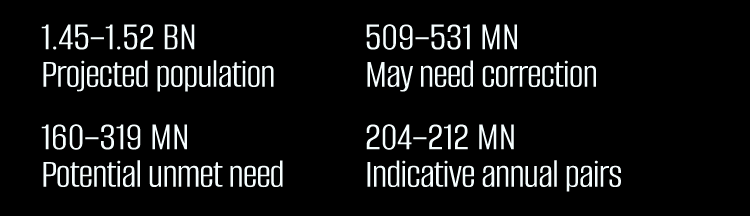
If 30% to 60% of those needing correction remain uncorrected or inadequately corrected, the potential unmet need ranges from roughly 160 million to 319 million. A midpoint assumption of 50% suggests about 255–265 million people. The range is deliberately broad because effective coverage varies by age, income, geography, awareness, service quality and spectacle use.
Two opportunities: public-health access and market development
Population scale makes Uttar Pradesh, Bihar, Maharashtra, West Bengal, Madhya Pradesh and Rajasthan central to national outcomes. Uttar Pradesh alone may have nearly 87 million people needing correction under the model. Yet population size is not the same as immediate commercial addressability.
High-population rural states require decentralised screening, affordable products, local workforce capacity, dependable referral and replacement systems. Urbanised, higher-income markets such as Maharashtra, Karnataka, Tamil Nadu, Telangana, Gujarat, Kerala and Delhi offer stronger prospects for organised retail, advanced lenses, premiumisation, multiple-pair ownership and technology-led services.
A generation-wise portfolio—not one spectacle market
- Children and Gen Alpha: school eye-health pathways, referral completion, durable first spectacles, follow-up and evidence-based myopia management.
- Gen Z: clinically sound correction combined with fashion, transparent pricing, fast delivery, regional design relevance and omnichannel convenience.
- Millennials and Gen X: rapidly rising presbyopia demand, occupational lenses, early progressives, accurate measurement and adaptation support.
- Older adults: refractive correction integrated with cataract, glaucoma, diabetic retinopathy, macular disease and low-vision referral.
The real measure: effective correction
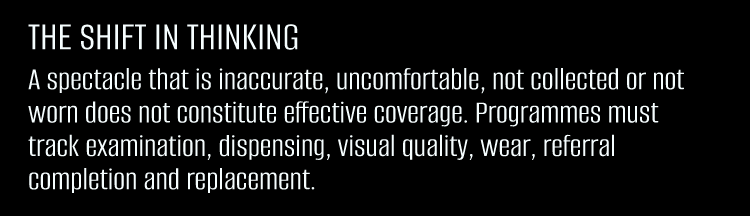
India’s correction gap cannot be closed by a single channel or by one-time camps. Fixed optical outlets, independent opticians, organised chains, hospitals, primary care, schools, workplaces, NGOs and digital platforms all have distinct roles. The common objective must be effective refractive error coverage: people receive appropriate services and achieve the intended visual outcome.
Capacity must grow with demand
An indicative annual opportunity above 200 million pairs would place heavy demands on examination capacity, lens and frame supply, laboratories, quality control and last-mile delivery. Priorities include consistent workforce standards, continuing education, rural recruitment, regional laboratories, digital tracking and networks. Independent opticians should be strengthened through training, shared technology and referral relationships.
Professional roles that turn access into effective correction
Optometrists are central to accurate refraction, presbyopia and myopia care, early detection of ocular disease, referral, follow-up, education and coverage monitoring. Their work connects community and school screening with appropriate clinical care and helps ensure that correction produces the intended visual outcome.
Dispensing opticians complete the pathway by translating a prescription into a well-fitted, verified and usable pair of spectacles. Accurate measurements, suitable product selection, final inspection, adaptation guidance and follow-up determine whether spectacles are collected, worn and replaced when needed.
Vision technicians extend the reach of the eye-care system, especially in rural and underserved communities. They support community and school screening, basic vision assessment, counselling, spectacle delivery, referral and follow-up, helping connect people identified with a need to optometrists, ophthalmologists and optical services.
NGOs can bridge gaps that neither public services nor commercial channels can close alone. Their strengths in community mobilisation, school and workplace programmes, services for vulnerable groups, local partnerships, patient navigation and outcome tracking can improve referral completion, spectacle collection, sustained wear and timely replacement.
For independent optical practices, alignment with SPECS 2030 is also a sustainable growth opportunity. Continuing education, shared technology and laboratory networks, stronger referral relationships and reliable service records can build trust, extend access and help independent practices participate more fully in school, workplace, hospital and community programmes.
Technology should solve defined bottlenecks
AI and digital systems can support demand forecasting, regional assortments, appointment triage, image-assisted screening, quality monitoring and prescription histories. They can also identify where patients are lost between screening, examination, dispensing and wear. Bias, weak validation, privacy failures and over-reliance on automation remain risks; technology should augment professional judgement.
A policy agenda aligned with WHO SPECS 2030
WHO SPECS 2030 calls for quality, affordable and people-centred refractive services and a 40-percentage-point increase in effective coverage by 2030. India should integrate refractive care with primary health and school systems, clarify regulation, support domestic manufacturing and collect comparable equity data.
Ten priorities for 2030
- Plan at state and district level, not through one national average.
- Replace flat assumptions with age- and state-specific evidence.
- Measure effective correction rather than spectacles distributed.
- Build universal school eye-health and follow-up pathways.
- Treat presbyopia as a productivity and inclusion issue.
- Standardise and expand the optical and optometric workforce.
- Support independent opticians alongside chains and hospitals.
- Invest in laboratories, logistics and last-mile delivery.
- Apply AI to forecasting and quality with professional oversight.
- Align public and private action with WHO SPECS 2030 and equity outcomes.
The full 40-page report contains the methodology, state and Union Territory estimates, generation-wise analysis, opportunity tiers, delivery framework, performance indicators, sources and limitations.