Dr. Rajeev Prasad MCOptom (UK) | M.Opt | FLVPEI (Low Vision) | BHMS (BU) Optometrist | Educator | Researcher | Myopia Expert | Neuro Rehab Specialist & Philanthropist Founder & Director – Visual Eyez & Eye GuRukul Clinical Associate: College of Syntonics (USA) Neuro Optometric Rehabilitation (USA) International Sports Vision Association Founding Chairman – International Academy of Orthokeratology & Myopia Control – India Chapter President Elect – World Council of Optometry
The world is witnessing a dramatic rise in myopia, commonly known as near-sightedness. Once considered a simple refractive error corrected with spectacles, myopia is now recognised as a major public health concern with potentially serious consequences for vision and eye health.
Today, children are spending more time indoors, engaged with digital devices, online learning, and near-work activities than ever before. Combined with reduced outdoor exposure, these lifestyle changes have contributed significantly to the rapid increase in myopia across the globe. As awareness grows and scientific understanding advances, the management of myopia is transforming the landscape of eye care, creating new opportunities for optometrists, opticians, ophthalmologists, educators, and the optical industry.
Understanding Myopia
Myopia occurs when the eye grows longer than normal, causing light rays to focus in front of the retina instead of directly on it. As a result, distant objects appear blurry while near objects remain clear.
Traditionally, myopia was corrected with spectacles or contact lenses. However, modern research has shown that myopia is not merely a refractive error, it is a progressive eye condition that can increase the risk of serious eye diseases later in life. The concern today is not merely whether a child can see the blackboard clearly but how much myopia they will develop over their lifetime.
The Global Myopia Epidemic: The Numbers Are Alarming
Myopia is increasing at an unprecedented rate worldwide and is now recognised as one of the most significant public health challenges in eye care.
Current estimates suggest:
■ More than 2.6 billion people worldwide are myopic. ■ By 2050, nearly 50% of the global population may be affected by myopia. ■ Approximately 10% of the world’s population may develop high myopia. ■ In several East Asian countries, myopia prevalence among school leavers and young adults already exceeds 80%.
India is also experiencing a rapid rise in childhood and adolescent myopia, particularly in urban areas. Factors such as urbanisation, increased academic pressures, prolonged screen time, online learning, and reduced outdoor activities have contributed significantly to this growing trend. Studies conducted before and after the COVID-19 pandemic have reported accelerated myopia progression among children, highlighting the impact of changing lifestyles on visual health.
Recognising the scale of the problem, the World Health Organization and leading vision care organisations now consider myopia a major public health concern requiring coordinated awareness, early intervention, and evidence-based management strategies.
Why Is Myopia a Concern?
Many parents assume that increasing spectacle power is a normal part of childhood. However, the real concern lies in the excessive growth of the eye. Every additional diopter of myopia increases the risk of future ocular complications.
Individuals with moderate to high myopia have a greater risk of developing:
Importantly, these risks remain even after refractive surgery because the underlying elongated eye structure remains unchanged.
Therefore, the objective is no longer just to provide clear vision but to reduce the rate of myopia progression and limit the final level of myopia achieved.
Why Is Myopia Increasing?
Modern lifestyles have changed dramatically over the last few decades, which has contributed to the rising prevalence of myopia.
Reduced Outdoor Activity
Research consistently demonstrates that children who spend more time outdoors have a lower risk of developing myopia. Exposure to natural daylight is believed to stimulate dopamine release within the retina, which may help regulate normal eye growth.
Current recommendations suggest:
■ At least 120 minutes of outdoor activity daily ■ Increased participation in sports and recreational activities ■ Reduced dependence on indoor entertainment
Excessive Near Work
Children today spend prolonged hours:
■ Reading ■ Studying ■ Using smartphones ■ Gaming ■ Watching tablets ■ Working on computers
Sustained near visual demand may contribute to myopia development, particularly when accompanied by poor visual habits.
Digital Device Use
Although digital screens may not directly cause myopia, excessive screen exposure increases near work demand while simultaneously reducing outdoor activity. Poor posture, short viewing distances, and prolonged continuous viewing can contribute to visual fatigue and accommodative stress.
Genetic Factors
Children with one myopic parent have a higher risk of developing myopia. The risk increases substantially when both parents are myopic. However, genetics alone cannot explain the rapid rise observed globally. Environmental and lifestyle factors play a critical role.
Lifestyle Modifications: The First Line of Defense
The Role of Parents and Schools
The simplest and most effective preventive strategy remains increased outdoor exposure. Parents and educators play a crucial role in protecting children’s vision.
Simple measures include:
■ Minimum two hours outdoors daily ■ Outdoor sports participation ■ Walking and recreational activities ■ School-based outdoor programs
Follow the 20-20-20 Rule
Every 20 minutes of near work: Look at something at least 20 feet away for at least 20 seconds. This helps reduce visual fatigue and accommodative stress.
Maintain Proper Working Distance
Recommended distances:
■ Reading: 30–40 cm ■ Computers: 50–70 cm ■ Children should avoid reading while lying down or holding devices very close to their eyes.
Advances in ocular biometry, corneal topography, and artificial intelligence are further enhancing the ability to monitor and manage myopia progression with greater precision.
Technology Is Changing the Way for myopia management
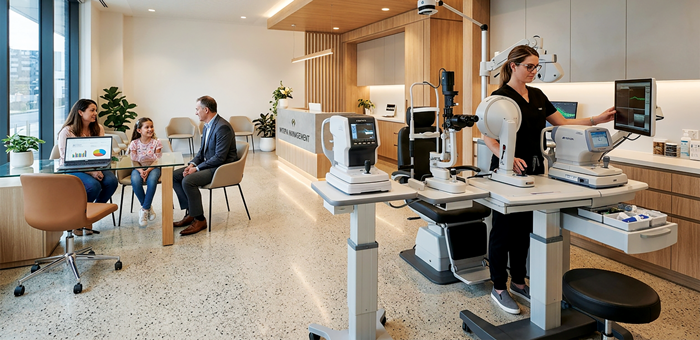
Modern myopia clinics increasingly rely on advanced diagnostic technologies. These include:
Axial Length Measurement
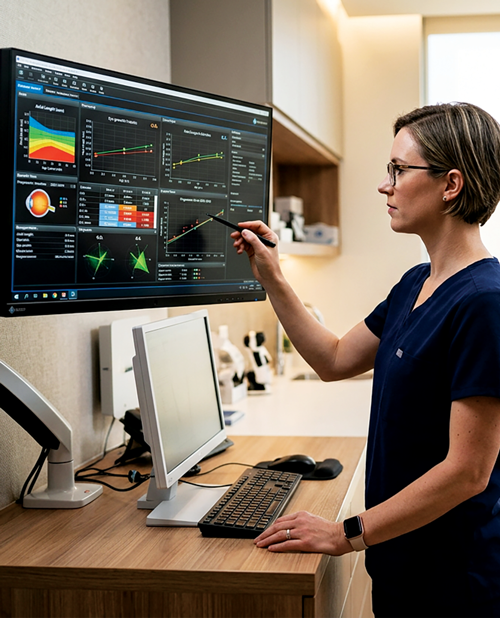
Axial length has become one of the most important biomarkers in myopia management. Monitoring of eye growth allows clinicians to:
■ Detect progression earlier ■ Assess treatment effectiveness ■ Educate parents using objective data
Corneal Topography
Topography assists in:
■ Orthokeratology fitting ■ Corneal health assessment ■ Specialty contact lens practice
Binocular Vision Assessment
Accommodation and vergence anomalies may influence visual comfort and treatment outcomes. Comprehensive myopia care increasingly includes binocular vision evaluation.
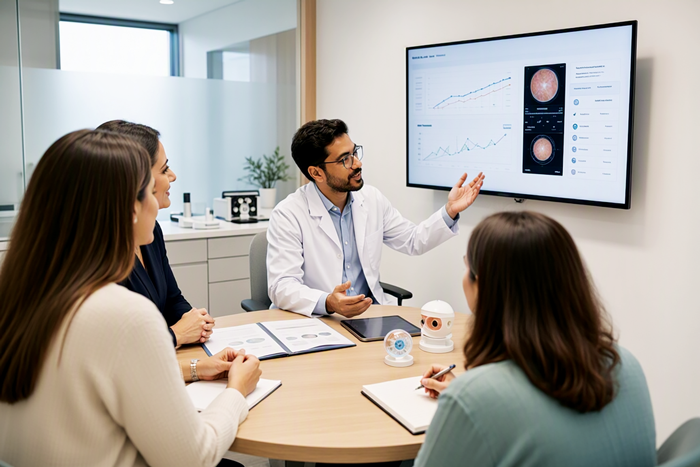
The growing burden of myopia presents one of the greatest opportunities in the history of optometry. Traditionally, optometrists focused primarily on prescribing spectacles and contact lenses. Today’s optometrist, however, is becoming a key player in preventive eye care and long-term vision management.
As awareness increases, demand for qualified optometrists trained in myopia management is expected to rise significantly.
The Future of Eye Care
The future of optometry is shifting from simply correcting vision to actively managing eye health and preventing visual disability. Myopia management clinics, specialty contact lens practices, paediatric vision services, and technology-driven eye care models are creating new career pathways for optometrists worldwide. Those who invest in advanced clinical skills, technology, communication, and patient-centred care will be well positioned to lead this transformation.
Conclusion
Myopia is no longer simply about wearing glasses. It is a progressive eye condition with significant implications for lifelong vision and ocular health. The growing prevalence of myopia presents both a challenge and an opportunity – challenging eye care professionals to address an emerging public health crisis while creating new avenues for innovation, preventive care, and specialised clinical services.
For parents and the public, awareness, early detection, regular eye examinations, and healthy visual habits can help protect children’s vision and reduce the risk of future complications. For optometrists and opticians, myopia management represents one of the fastest-growing areas of modern eye care, requiring advanced clinical knowledge, technology, patient education, and long-term monitoring.
The future of eye care is shifting from simply correcting blurred vision to actively managing eye growth and preserving vision for life. As evidence-based myopia management continues to evolve, practices equipped with advanced diagnostic technologies and specialised expertise will play a critical role in safeguarding the visual health of future generations.
Among the practices contributing to this evolving field is Visual Eyez India, one of the early optometry centres in India to establish a dedicated myopia management facility. The practice is equipped with advanced diagnostic technologies, including an Optical Biometer for precise axial length monitoring, Pentacam® with Corneal Scleral Profile (CSP) for detailed anterior segment and specialty lens assessments, and the Keratograph® with Dry Eye Evaluation for comprehensive ocular surface analysis.
These technologies support the accurate diagnosis, monitoring, and management of myopia progression while also helping clinicians assess associated ocular conditions that may influence treatment outcomes. By combining advanced diagnostic capabilities with evidence-based clinical care, Visual Eyez India aims to provide personalised myopia management solutions focused on preserving vision and promoting long-term eye health in both children and adults.